TSB: news

Sports news and updates

Hot

Showing posts with label news. Show all posts

Tuesday, 21 July 2020

New on Sports Illustrated: Dwight Howard Dropped the Most Absurd Quote About the Coronavirus: TRAINA THOUGHTS

July 21, 2020 0

Lakers' center Dwight Howard has no clue how the coronavirus works

1. Congrats to Lakers center Dwight Howard. He has the honor of giving us the most ridiculous quote we've seen from an athlete during quarantine.

Howard has already been clear that he isn't into wearing a mask and

even claimed last week that someone called the NBA bubble hotline to report him for not wearing one.

But it's not surprising that Howard would be anti-mask when you realize how completely ignorant he is about the virus. Which leads me to Howard's mind-boggling quote.

According to USA Today, Howard said the following during an Instagram Live on Sunday: “I didn’t know that the coronavirus be flying through the air looking for people.”

THAT'S EXACTLY HOW THE F---ING VIRUS WORKS!!!!!!!

Corona is all about droplets, droplets, droplets. Does Howard think people are wearing masks as a fashion statement? No. They are wearing masks so that they don't spread their droplets.

How can anyone, at this stage of the game, basically five months from the start of this insanity, still not understand how corona spreads? I understand that we have been given a lot of mixed messages about the virus and nobody really knows anything.

And, yes, early on, experts said people didn't need to wear masks. But those experts reversed course on that in April/May. It's been made crystal clear since then that the best way to curtail the spread of corona is to wear a mask.

How on earth can Howard fail at grasping this concept?

2. Kneeling during the national anthem will be a theme for each sport that returns to action. Mavs owner Mark Cuban is fed up with the national anthem police, AND he will gladly help you with any boycott aimed at him.

3. Rockies outfielder David Dahl perfectly sums up the 2020 baseball season right here.

4. Bud Light has reworked the lyrics for Take Me Out to the Ballgame for its newest commercial, and it's pretty amusing.

5. The latest Sports Illustrated Media Podcast features an interview with TSN SportsCentre host Jay Onrait.

The very funny Onrait talked about highlight shows not being dead, how he's managed to do a highlights show for four months without sports, why his stint at FS1 from 2013 to 2017 was doomed from the beginning, what it's like to be part of an iconic partnership, dream podcasts guests, The Hangover and much more.

You can listen to the podcast below or download it on Apple, Spotify, Stitcher and Google Play.

6. RANDOM VIDEO OF THE DAY: I'm stealing this from the Howard Stern Show, because they played parts of this video this morning and it was a major combination of funny and infuriating. Dwight Howard isn't alone, obviously, in being ignorant about wearing a mask. Here's what happened when two bros tried to hand out free masks in Huntington Beach, Calif.

7. SPORTS VIDEO OF THE DAY: This is an excellent brawl from 1996 involving the Phillies and Expos and starring Pedro Martinez.

Be sure to catch up on past editions of Traina Thoughts and check out the Sports Illustrated Media Podcast hosted by Jimmy Traina on Apple, Spotify or Stitcher. You can also follow Jimmy on Twitter and Instagram.

Read More

New on Sports Illustrated: LeBron James Is About to Prove He's the MVP, Again: Unchecked

July 21, 2020 0

LeBron James likely won't win MVP, but he's about to show why he should, again.

LeBron James knows Giannis Antetokounmpo is going to win MVP and that’s a problem for the rest of the league.

Because let’s be honest, as I’ve said many times, a healthy LeBron is always the most valuable player in the NBA, and everyone knows it. James included.

It’s almost cute at this point that people will again wait until the playoffs are over before the realization hits them. Taking nothing away from Giannis, he’s a beast. But the statistical difference simply isn’t enough for me given that the Los Angeles Lakers were outscored with James off the floor and since he was averaging more than 25 points a game and leading the league in assists, all while showing a renewed commitment on D. 

And as for the record? LeBron pointed out what would’ve been used against him before. The Greek Freak and the Milwaukee Bucks are doing it in the East, while James and company have made light work of the supposedly mighty West. I guess that argument doesn’t matter anymore because of Anthony Davis or something.

But let me point something else out, the New York Knicks have won a playoff game more recently than the Lakers, who are now the favorites to win it all.

I wonder why that is? Probably the same reason the Cleveland Cavaliers went from the Finals to the Lottery and now being unable to even qualify for the bubble. It’s likely better this way, as it is even more motivation for LeBron’s “Revenge Season”.

Because while the Most Valuable Player in the history of the sports might not get the votes to win the MVP award, he'll certainly have all the eyes when the NBA returns. 

Read More

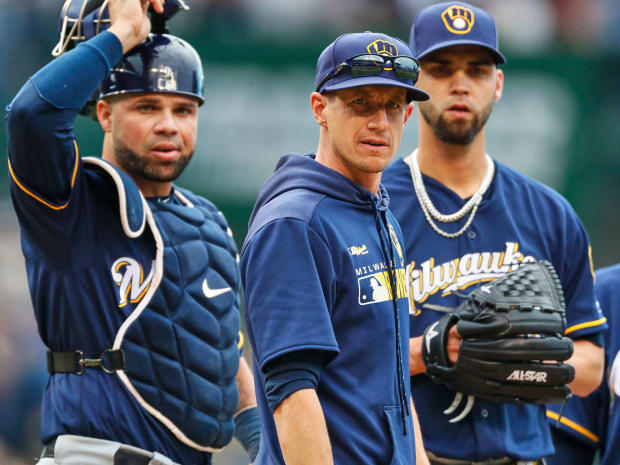
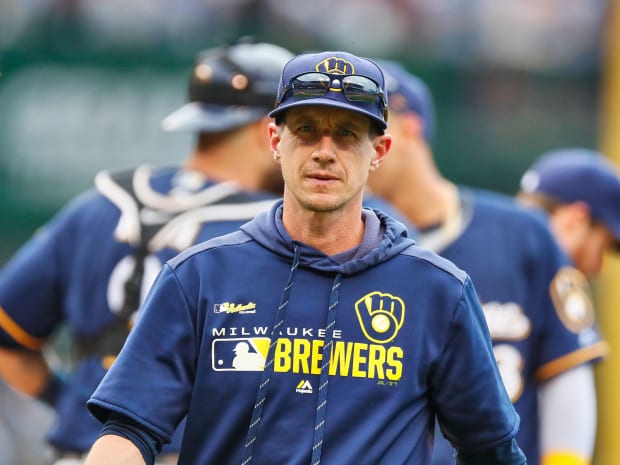
New on Sports Illustrated: Why Brewers Manager Craig Counsell Is Perfectly Suited for an Unusual Season

July 21, 2020 0

The Brewers manager is better equipped than any other to leverage all of MLB's changes in 2020.

Milwaukee Brewers manager Craig Counsell is to a roster and nine innings what a manual juicer is to an orange: whatever is in there he will wring out, even if it creates an aesthetic mess. Over the past three years no National League team has received fewer innings from its starting pitchers, which used to be a recipe for failure, but for Milwaukee it means two playoff appearances and three straight years with 86 or more wins, tying a franchise-best run.

Now stand back and tighten your apron, because the mad chef of Milwaukee is about to create another beautiful mess.

Think of this improvised baseball season as a bake-off among managers. Among their new rules of engagement: a short training camp, a 30-man roster for the first two weeks, extra innings that start with a runner at second base, a three-batter minimum for mid-inning relievers, a DH in the NL, and a 60-game

season, which prioritizes running games with urgency.

Managers are being put to the test. No manager is better equipped to leverage such changes than Counsell. Why?

“The greatest quality he has is that he is undeterred,” said Brewers bench coach Pat Murphy, who also was Counsell’s coach at Notre Dame. “He will do what he thinks is right. Period. ...If it means a veteran like Ryan Braun is not happy about not being in the lineup, he’s not going to change his mind if he thinks it’s the right thing to do. Most managers don’t operate that way.”

Counsell is the guy who once pulled his starting pitcher after one batter of an NLCS game (now illegal), who has made at least one pitching change in 416 consecutive regular season games, and who last year used 159 different lineups in 162 games and who led all managers with 11 two-inning saves.

Oh, and this year, as if to heighten the degree of difficulty while juggling chainsaws, he has a dozen new players on his roster and must preach COVID protocols to his players as much as he does cutoffs and relays.

“Our first goal was just to make friends in spring training the first time,” Counsell said. “I think we had already done that when we started up again. Now we talk about how the circumstances connect us in a really deep way. We’re all depending on one another to make this work, just from a health perspective.

“It’s also kind of funny that there is less going around the team, so that you rely on each other a lot more. It’s like our group, if you want to say it this way, is in its own bubble.

“I haven’t been thinking about the season too much. I’ve been thinking about health issues more than anything–COVID and physical health. I’ll figure out the season when we get to it next week. Right now on a daily basis I think about how we have to get the health stuff right.”

Suffice to say, Counsell will use the incremental 30-, 28- and 26-man rosters the way Jackson Pollack would a sale on paint. He is in his element. The results are inarguable. Over the past three years Milwaukee is the best team in baseball at outperforming its expected record based on runs scored and allowed (+14 wins), it is the best team in one-run games (85-59) and it is the best team in the league in September, the traditional month of expanded rosters (56-26).

Finding incremental edges is enormously important for Counsell and the Brewers, who despite playing in baseball’s least populated Combined Statistical Area (about 2 million people) have played just one meaningless game in the past three years. Milwaukee was eliminated in Game 161 in 2017, clinched the NL Central title in Game 163 in 2018, and sealed the wild card in Game 162 last year.

One of the ways Counsell finds those edges is in his creative use of pitchers, or as he calls them to account for their amorphous roles, “out-getters.” The Brewers have only one pitcher who has thrown 150 innings in a big-league season, and that is oft-injured Brett Anderson. But Counsell can mix and match roles for versatile arms such as Brent Suter, Freddy Peralta, Josh Lindblom and Corbin Burnes while giving steady if abbreviated work to starters Brandon Woodruff and Eric Lauer.

“When you get more players [on a roster] it should help you,” Counsell said. “For us I think we have a good number of pitchers lengthened out. It can help us get through stretches of lineups. Maybe it’s not the one guy who’s going to go 100 pitches, but it’s about seven or eight guys who can get outs and are lengthened out. It’s almost like having two starters in a game.”

That same gig-economy philosophy applies to how Counsell will deploy the DH. While many observers have speculated the role is suited for Ryan Braun, Counsell has a shared system in mind.

“The position players will be challenged right off the bat,” Counsell said. “Playing nine innings daily after a quick run up and not having their legs underneath them is a challenge. We’re going to be running guys through the DH spot … [Christian] Yelich, [Avisail] Garcia, [Keston] Hiura … it’s how you keep them fresh by still having their bat in the lineup.”

One familiar move Counsell will not be able to make is to drop a specialty reliever into a game mid-inning to face one or two batters. He did that with Alex Claudio 29 times last year, second most among NL relievers. In a rare, ham-handed intrusion into the strategy of the game, MLB decreed such relievers now must face at least three batters (unless the pitcher gets the third out of the inning).

“Look, I think we have to be careful about how we continue to just limit things,” Counsell said. “I think rightfully baseball is trying to address the pace of game issue. I would hope we do it in a way that doesn’t affect the game strategically and tactically, and that it gives players, not just managers, the ability to showcase a bunch of different skills because I think that’s important.”

Counsell was born in Whitefish Bay, Wis., in 1970, the same year the Milwaukee Brewers were born, which means both turn 50 this season, which seems a clerical error when you see the preternaturally youthful Counsell still at his playing weight, rocking a hoodie and maintaining in his walk that distinct bounce off the balls of his feet.

Counsell has made a career out of defying numbers. Unrecruited, he followed his father, John, to Notre Dame. Murphy knew the competitor he had on board one day when as a freshman Counsell was taking grounders at second base. The ball took a bad hop and smashed him in the face, breaking his nose and pushing it to an awkward angle. Support personnel rushed him to a hospital.

“Two hours later,” Murphy said, “I look up and he’s back at practice, all bandaged up. He just shows up and gets right back in line taking grounders at second base.”

An 11th round pick, Counsell played in the majors until he was 41, finally bowing out after a season in which he endured an 0-for-45 stretch as a bench player with the 2011 Brewers.

“I felt bad for the manager, I did,” said Counsell, referring to Ron Roenicke, now the Red Sox manager. “Look, I was miserable. I always felt my job … it wasn’t necessarily that important that I played good on that team. What was important was that our really good young players played good. So how I reacted to it was really the most important thing.

“You try to get hits, but I thought what Prince Fielder thought of how I handled it was really important to me. You take that same trait now as a manager. It doesn’t mean you’re perfect, man. Sometimes you lose your cool. But you try to handle it right.”

Upon retiring, Counsell took a job in the Brewers’ front office under GM Doug Melvin. In May 2015 Melvin asked Counsell to replace Roenicke as the team’s manager. Four months later, David Stearns was hired to replace Melvin. During the interview process Stearns asked around baseball for opinions on Counsell. What he heard convinced him to stick with the manager he inherited.

“The constant feedback was that he was in incredibly intellectually curious guy,” said Stearns, who last winter extended Counsell’s contract through 2023. “He has this edge about him because he’s an intense, competitive guy. But underneath that he’s incredibly curious, and that really intrigued me. Let’s face it, you don’t hear that a ton among baseball people–someone being described as curious. That’s the term I got fairly regularly.”

Just five years later, Counsell is the longest tenured manager in the NL, and fourth longest overall. Ten teams changed managers this offseason (the Mets did so twice), and 17 over the past 20 months. Teams increasingly emphasize the ability to connect with players and fluency in analytics above experience. Counsell gave an example of how quickly the job has changed: his first spring training staff meeting, in 2016, consisted largely of him and “seven or eight coaches.” For the same meeting this year 45 people filled a room at their Arizona training complex.

“I actually think with all the information we have right now and all the decisions we charge managers with in-game, the role of the manager is more important now than it’s ever been,” Stearns said. “It’s much harder. In an era when you expected your starting pitcher to go seven or eight innings the manager could basically take the first four, five or six innings off.

“Craig has to manage literally from pitch 1. That’s partially from how the game is run right now, but it’s also because of how we have constructed our roster and our pitching staff. Here in Milwaukee the job takes on added importance.”

In managing 11 postseason games Counsell never has allowed a starting pitcher to throw six innings or face more than 21 batters. In the wild card game last year against Washington he tag-teamed four pitchers to wind up with his closer, Josh Hader, on the mound with a 3-1 lead and two outs in the eighth inning. The Nationals scored three times to win, 4-3.

The game flipped in such a short amount of time–“We went from winning to losing in eight or nine minutes,” he said–that he remembers walking to the clubhouse being unprepared for addressing his team.

“I failed at that,” he said. “Probably what stings is that the game went to script for us.

“Then … baseball happened. And you’ve got to live with it. Hopefully you’re in it long enough and give yourself enough chances and you get those breaks in one of those games. I was on the other side of it, too.”

As a player Counsell was 4-0 in winner-take-all games. He was in the middle of winning rallies in the last two World Series decided in walk-offs: 2001 with Arizona and 1997 with Florida.

The Brewers never have reached the postseason three straight years. To bring them back to their usual last-weekend relevancy, Counsell with have to knit a bevy of new players into his unorthodox system, including pitchers Anderson, Lindblom, Lauer and David Phelps, catcher Omar Narvaez, infielders Luis Urias, Justin Smoak, Logan Morrison, Eric Sogard, Brock Holt and Jedd Gyorko and outfielder Garcia.

“Our challenge this year is connecting the group again and having to start over with a number of new faces,” Counsell said. “We still have a great group of core players here. Now I know we’ll be successful at it because of guys like Ryan Braun, Lorenzo Cain and Christian Yelich. They do as much if not more than I do. That’s what’s important with so many new faces.”

Expanded rosters and bullpen usage could depress offense, though Counsell said, “I kind of go the other way to be honest. I still think if you can get to the back of teams’ pitching staffs you can score runs. And you will get to the back of team’s pitching, especially early in the season. We have to be so careful with pitchers. Even your best late-inning arms, how much are you going to use them? I don’t think you can use them a lot early.”

Dodging COVID, new rules, a short season … in many ways this is the most unpredictable and unconventional of baseball seasons, which is to say it perfectly suits Counsell and his Brewers.

Read More

New top story from Time: Report on Russian Influence Criticizes U.K. Officials For Not Investigating Meddling in Brexit Referendum

July 21, 2020 0


(LONDON) — A long-awaited report on Russian influence in British politics criticized the British government for neglecting to investigate whether Russia interfered in the 2016 Brexit referendum, describing its utter lack of curiosity about the threats to democracy as being a major failure at the heart of power.

The parliamentary report’s authors accused the British government of “actively avoiding” looking into evidence of the Russian threat to the EU referendum. The authors found this particularly unforgivable given the evidence that emerged of Russian interference in the U.S. elections and in the Scottish independence referendum in 2014.

“There has been no assessment of Russian interference in the EU referendum and this goes back to nobody wanting to touch the issue with a 10-foot pole,” committee member Stewart Hosie said, demanding that such a study be done and the public informed.

While the report from the parliament’s Intelligence and Security Committee said it would be “difficult — if not impossible — to prove” allegations that Russia sought to influence the referendum, it was clear that the government “was slow to recognize the existence of the threat.”

Committee members concluded that the goal of a resurgent Russia in influencing the vote would be to amplify existing divisions, and thus possibly destabilize Western political systems.

In a 20-page response, officials denied the government had “badly underestimated” the Russian threat and rejected the call for an assessment of alleged Russian meddling during the Brexit referendum.

“We have seen no evidence of successful interference in the EU Referendum,” the statement said.

The report says Russia sees Britain as one of its top intelligence targets in the West. It said Russian influence in the U.K. is the “new normal,” and successive governments have welcomed Russian oligarchs with open arms. Russians with “very close links” to President Vladimir Putin were “well integrated into the U.K. business, political and social scene — in ‘Londongrad’ in particular,” it said.

Speaking before the report was released, Kremlin spokesman Dmitry Peskov said Tuesday that Russia “never interfered in electoral processes,”not in the United States, not in Britain, not in any other country.”

“We don’t do that ourselves and we don’t tolerate when other countries try to interfere with our political affairs,” Peskov said.

The report’s authors said they were subjected to an unprecedented delay in making the document public, with officials holding off its release for more than six months. Critics have claimed that was meant to shield Prime Minister Boris Johnson and his Conservative Party from embarrassment.

The committee did not offer a theory as to why the government delayed the report, but did say the government’s explanations for delaying the report were not true.

The report was originally submitted to Johnson on Oct. 17. The government initially said it couldn’t be published until it was reviewed for national security issues, which postponed its release until after the Dec. 12 general election. Further holdups were caused by delays in appointing new members to the Intelligence and Security Committee.

Finally, Johnson named five Conservative lawmakers to the nine-person panel in hopes his handpicked candidate would be chosen as chairman and block the report. The gambit failed when a renegade Conservative was chosen to head the committee with backing from opposition parties.

The opposition Labour Party has accused the government of failing to publish the report because it would lead to further questions about links between Russia and the pro-Brexit campaign in the 2016 referendum on European Union membership, which Johnson helped lead.

Another parliamentary panel — the Digital, Culture, Media and Sport Committee — previously published the results of its own inquiry into disinformation and “fake news,” which called on election regulators and law enforcement to investigate reports that a British businessman with links to Russia donated 8.4 million pounds ($10.6 million) to the Brexit campaign. The National Crime Agency said in September that it found no evidence of criminal offenses related to the donation.

The intelligence committee report covered the full range of the Russian threat to the U.K., including election interference, espionage and targeted assassinations such as the attempt to kill former spy Sergei Skripal in the English city of Salisbury two years ago.

The report urged British authorities to beef up their defenses, saying the “clearest requirement for immediate action” was for new legislation to give tools to the British intelligence community faced with a “very capable” adversary and to battle espionage, illegal financial dealings of Russian elite in Britain and their “enablers.”

It called for better coordination with Britain’s Western allies, and said Britain should be ready to lead international action and should work to develop new rules on “offensive cyber” operations.

It faulted unspecified social media companies for “failing to play their part” and said the British government should set up rules to “ensure that they take covert hostile state use of their platforms seriously” and “name and shame” those that fail to act.

The report’s release comes only days after Britain, the United States and Canada accused hackers linked to Russian intelligence agencies of trying to steal information from researchers working on a potential coronavirus vaccine.

Read More

New on Sports Illustrated: NWSL Reveals 2022 Los Angeles Expansion Team With Loaded Ownership Group

July 21, 2020 0

Serena Williams, Abby Wambach, Mia Hamm, Natalie Portman and a host of other stars, celebrities and industry leaders are bringing the NWSL to Los Angeles.

The NWSL is expanding to Los Angeles—and it's doing so in a very L.A. way.

A loaded ownership group that features a slew of former U.S. women's national team stars (including Mia Hamm, Abby Wambach, Julie Foudy and Lauren Holiday), celebrities (including founder Natalie Portman, Eva Longoria, Jessica Chastain, Jennifer Garner and Uzo Aduba) and industry leaders (including Kara Nortman, Julie Uhrman and Alexis Ohanian)

and many more will steward the league's 2022 expansion team in the city, which for now is going by the moniker Angel City.

The L.A. team will become the NWSL's 11th after Racing Louisville FC joins in 2021. 

“The growth trajectory of the NWSL is incredibly exciting, but we also need to be strategic and thoughtful about how fast we expand and the communities we partner with,” new NWSL commissioner Lisa Baird said in a statement. “We’ve long sought the right partner in L.A. considering the NWSL fanbase that already exists in the region and the massive interest in women’s soccer in general. Those factors, along with an incredible ownership group make this an ideal situation and we couldn’t be more thrilled to move forward.”

While Hamm is involved, there is no indication that MLS's LAFC, which has its own star-laden ownership group of which she is a part, is backing this project. It's unclear where the new team will play and whether perhaps LAFC's Banc of California Stadium or the L.A. Galaxy's Dignity Health Sports Park will be its home venue. According to the Los Angeles Times, Uhrman, a media and gaming entrepreneur, and the Galaxy have been in conversations regarding a role with the club.

Banc of California stadium was the site of an April 2019 friendly between the U.S. women's national team and Belgium–one attended by Portman, Longoria, Chastain, Garner and Aduba. Their involvement with the game in the city, clearly, was not limited to that appearance.

“Today we take an exciting step by announcing the first women majority-owned and led ownership group,” Portman said. “I am thrilled by the opportunity to partner with this incredible group of people to bring a professional women’s soccer team to Los Angeles. Together, we aim to build not only a winning team on the field, but also to develop a passionately loyal fan base. We also hope to make a substantive impact on our community, committing to extending access to sports for young people in Los Angeles through our relationship with the LA84 Foundation. Sports are such a joyful way to bring people together, and this has the power to make tangible change for female athletes both in our community and in the professional sphere.”

The ownership group also includes what has to be a first in sports: a 2-year-old. The daughter of tennis icon and club investor Serena Williams and lead founding investor and Reddit cofounder Ohanian, Alexis Olympia Ohanian Jr., is also listed in the ownership group that numbers more than 30 people.

“I am proud to be a part of this wonderful group working to bring a women’s professional football club to Los Angeles,” Ohanian said. “Chiefly, because I’m a fan of the game, but also because I believe there is massive potential for the sport and it’s been undervalued by too many people for far too long. As someone who spends hours kicking around a football with my 2-year-old daughter, I want her to have a front row seat to this revolution. I’m personally investing on behalf of my family because creating more opportunities in women’s sports is important to my wife and me, and we want to be a part of making a better future for our daughter.”

The club will mark the return of first-division professional women's soccer to Los Angeles after the folding of the Los Angeles Sol. The club that featured Marta, Camille Abily, Aya Miyama and a host of other top players lasted one season in the old Women's Professional Soccer league. Shannon Boxx, the Sol's first player, is also involved in the Angel City project.

The NWSL is currently wrapping up its return-to-play tournament, with the semifinals of the Challenge Cup in Utah taking place on Wednesday. The Portland Thorns and Houston Dash will meet in one, while Sky Blue FC and the Chicago Red Stars will meet in the other, with the winners advancing to Sunday's final at Rio Tinto Stadium.

Read More

New on Sports Illustrated: Tobias Harris Uses Media Session to Call for Arrest of Breonna Taylor’s Killers

July 21, 2020 0

Tobias Harris used his entire media session on Monday to call for the arrest of the police officers who killed Breonna Taylor.

He only had one thing to say

By the time the NBA plays its first games in Orlando, it will have been nearly five months since police in Louisville shot and killed 26-year-old Breonna Taylor in her home. The cops who shot her remain free, and Sixers forward Tobias Harris doesn’t want people to forget it. 

Harris’s message during his time with the media on Monday was brief but crystal clear: Arrest the officers who fired more than 20 shots and hit Taylor eight times. 

Harris was asked about the

T-shirts with social justice messages that Russell Westbrook and the NBPA are producing and whether players plan to feature them at all during this season.

“Nothing against the T-shirts, but we want to make sure that [Kentucky Attorney General] Daniel Cameron will arrest the cops and officers involved with Breonna Taylor’s death. And that’s all I’ve got to say,” Harris said. 

When another reporter tried to ask a question, he continued, “That’s going to be my answer for every question. Daniel Cameron, step up. Do what’s right. That’s the only message I’ve got today. I appreciate everybody. Thanks.”

People from around the country are continuing to put pressure on the people in charge in Kentucky and Louisville. Protestors have gathered in the streets daily for nearly two months now. Texans receiver Kenny Stills was among those arrested last week at a protest. NBA players like Harris can’t be there in person to lend their support but they can help keep the issue in the public consciousness by speaking out. 

The best of SI

Black college football recruits are listening to how coaches are talking about the ongoing racial reckoning. ... The SI staff’s predictions for an abbreviated MLB season. ... Burning questions about the NBA’s restart. ... The language barrier was no obstacle for manager Marcelo Bielsa in leading Leeds to Premier League promotion

Around the sports world

Antonio Brown says he’s retiring from the NFL (again). ... The NFL is reportedly moving toward a season with no preseason games. ... Dwight Howard says he doesn’t believe in vaccines or wearing masks.

Take that, Mickey Mantle!

Very fun!

Steven Adams is a delight

Bielsa’s a good guy, too

It’s even cool without fans

Must cop

View the original article to see embedded media.

A lesser player would have missed this shot

Not sports

The Christopher Nolan blockbuster Tenet, which keeps getting pushed back, has now been delayed indefinitely. ... Dennis Quaid admitted that he initially thought Lindsay Lohan was actually a twin in The Parent Trap.

This guy just discovered brewing coffee

It looks like a candy

Saw vs. non-cuttable metal

Slow-mo footage of the Gateway arch being struck by lightning

A good song

Email dan.gartland@si.com with any feedback or follow me on Twitter for approximately one half-decent baseball joke per week. Bookmark this page to see previous editions of Hot Clicks and find the newest edition every day. By popular request I’ve made a Spotify playlist of the music featured here. Visit our Extra Mustard page throughout each day for more offbeat sports stories.

Read More

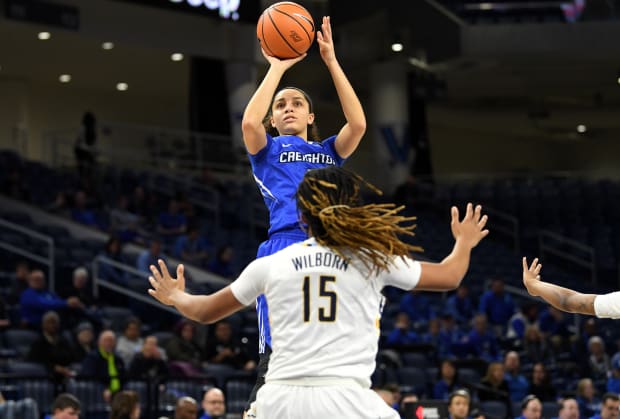
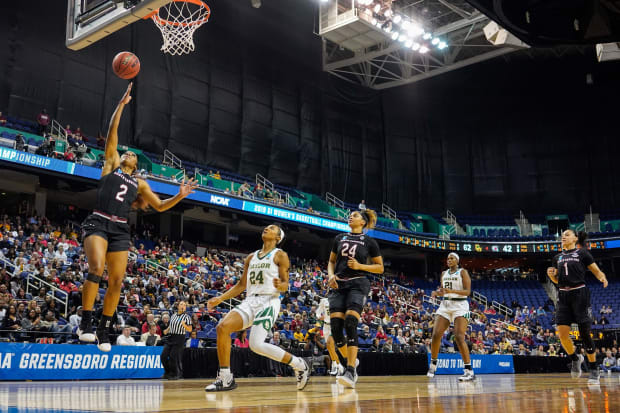
New on Sports Illustrated: On the Wubble: WNBA Draftees Are Getting a Second Chance

July 21, 2020 0

Meet some promising players who are getting a second look, courtesy of pandemic opt-outs.

Jaylyn Agnew was social distancing in Omaha, spending time lakeside and improving her comfort level with ball screens, when in June she received a couple of calls she hoped would come.

The Mystics drafted Agnew, the 2020 Big East Player of the Year, in April, but WNBA training camp had been canceled, just like her final NCAA postseason tournament. Then, Washington waived Agnew as the team finalized its 2020 roster. So, she shifted her focus to securing a contract to play overseas in Russia starting in September while refining her skills in case another WNBA opportunity came up.

The first call from Atlanta Dream head coach Nicki Collen, following WNBA vet Renee Montgomery’s decision to sit out the 2020 season, was to inform Agnew of her interest.

The next day, the coach asked her whether she wanted to join the Dream.

“I was like, Heck yeah,” Agnew says.

Agnew’s situation is unique to 2020 WNBA rookies, who transitioned from the college level to the pros, a time already filled with change and uncertainty, during a pandemic. Out of 36 draft picks, 17 rookies made rosters, 16 were waived and three chose to sit out for the 2020 season. As a result, supremely talented players don't have—or almost didn't have—homes in the league this year.

The upcoming season is set to begin on Saturday in Bradenton, Fla., where the league’s players and staff will live throughout the season and playoffs. Each team will play 22 games and practice at IMG Academy over the next few months.

Long before draft day, it was clear rookies would have a tough time making teams' 12-person rosters. A blockbuster free agency filled with trades and pay upgrades under the new CBA created an environment that meant five of the league’s 12 teams would have enough space under its salary cap to sign only 11 players. To boot, rookies weren’t able to increase their visibility during the NCAA tournament or compete for a spot during training camp.

“There’s a reason why we invited everybody we did to camp. There’s a reason why we drafted every player,” says Collen, whose roster initially included two rookies and eight total newcomers. “And when you don’t get the opportunity to see those players battle for spots, it’s disappointing. It’s heartbreaking because I was once that player. I know that feeling and wanting to be good enough and wanting that opportunity and loving the game.”

Jaylyn Agnew will suit up for the Dream this season, after being cut by the Mystics.

***

Making the cut depends a lot on where a player lands. Washington was one of those teams that had room for only 11 players, after signing both Emma Meesseeman and Elena Delle Donne to new max contracts and acquiring Olympian and 2012 WNBA MVP Tina Charles in a trade. Charles won’t play during the 2020 season for medical reasons, and Delle Donne is unlikely to. Mystics head coach Mike Thibault said the team will continue to pay Delle Donne as she recovers from back injury. Agnew, along with the Mystics’ third-round choice, Sug Sutton, were cut, as were most rookies on 11-players teams. The rebuilding New York Liberty would keep six rookies (and they’ve since added another), but the L.A. Sparks had none.

Only half of 2020 second-round picks made rosters for the May 26 deadline, which was created so players could begin receiving pay on June 1. The lack of visibility especially hurt third-rounders like Erica Ogwumike, who Lynx GM and manager Cheryl Reeve said had a realistic chance to make the final cut in Minnesota.

The Storm drafted Duke’s Haley Gorecki at No. 33 on April 17. She is a versatile guard who played a massive role in Duke’s entry into the NCAA tournament conversation last season due to her ability to get into the lane or score from three-point range. As a redshirt senior, she averaged 18.0 points, 6.5 rebounds, 4.0 assists and 2.0 steals, something no other Power 5 player did last season.

The Storm waived Gorecki on May 26. It was the first time she’d been cut from a team. Seattle’s lone 2020 rookie is Ezi Magbegor, who was drafted in 2019. The organization announced on draft night that its 2020 first-round pick, Latvian Kitija Laksa, would not be competing in the WNBA this season.

Seattle’s final roster is mostly made up of the players who won the WNBA title in 2018. And while Gorecki understands the situation and that players needed to get paid, there’s a sting that comes with being cut without having a chance to prove yourself.

“I would get super frustrated and upset and my brother would go like, ‘Haley, it’s out of your control,’ ” she says. “This whole process has been very fun, and I know my career will still go on. I’m staying optimistic. I’m really excited for everything to happen that’s coming and for next year as well.”

She wants to play for as long as she can and is preparing to play for Basket Zaragoza in Spain. While with her family in Palatine, Ill., the self-proclaimed gym rat has kept working out consistently in her routine. She normally doesn’t sit still long enough to binge too much TV, but she has watched Outer Banks and Tiger King.

Meanwhile, two third-round picks, Mikayla Pivec and Kiah Gillespie, were designated as “Non-Active” by the Dream and the Sky, respectively, which means they’ll sit out the 2020 season but the teams would retain their rights, and they’ll have a spot to land for training camp in 2021. The other third-rounders were waived.

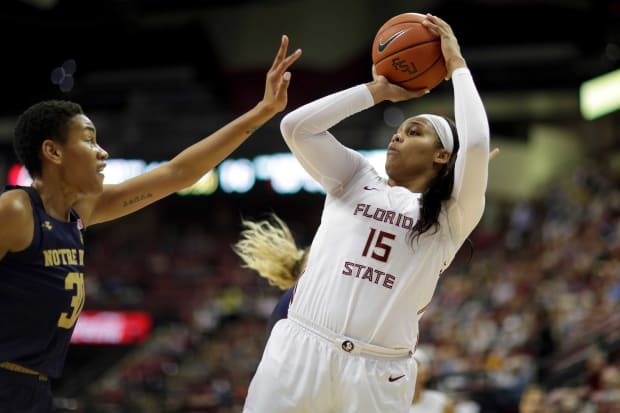
“I mean, of course I wanted to come in and, you know, play in the WNBA and have that opportunity,” Gillespie says. “But I think if you look at the bigger picture, maybe it is the better chance for me to develop and then come back.”

Gillespie calls this moment in life a blessing in disguise. At FSU, she played as a stretch four with the footwork and skills to score in the paint as a post, but could hit from three or dish to a transitioning teammate. In the WNBA, she would likely have transitioned to the three, or small forward, position. Now, she’s moved back home to Connecticut and regularly shows up for tea time with her mom—whether it’s 7:30 a.m., 9 a.m. or 11 a.m.—and competes on Madden with her brothers. She’s signed to play in Israel for Maccabi Ra’anana for the 2020–21 season.

The Sky originally went with 11 players for its final roster after offseason trades and signings were made to keep the core that made the 2019 playoffs under first-year coach James Wade intact. Ruthy Hebard, the team’s No. 8 pick out of Oregon made the cut. But following a mutual decision between Gillespie and the Sky, she will sit out the season, play overseas and wait for training camp in 2021.

The Sky’s Diamond DeShields left the University of Tennessee and played in Turkey before entering the WNBA draft. DeShields reached out to Gillespie with advice.

“ ‘Use this as fuel,’ ” Gillespie recalls. “ ‘Take this step and be able to come in and be ready for what’s next.’ And I think that was really huge. And I definitely think her process wasn’t perfect. [But] I think what she did is what helped her be where she is now.”

Gillespie, who wants to eventually become a college coach, says her redshirt year in 2017–18, after transferring from Maryland to Florida State, prepared her for this moment. It’s when she learned discipline and revamped her attitude and game.

“It definitely taught me what it was like to basically have to build yourself up all over again.”

Kiah Gillespie will have a shot in the Sky's 2021 training camp. "I think if you look at the bigger picture, maybe it is the better chance for me to develop and then come back," she says.

***

The obstacles that hurt players have now created a new chance for those on the margins of rosters.

Players have the option to opt out of the season, like Montgomery, who plans to focus on social justice work, and multiple have. And like Agnew, athletes are getting new opportunities to play. Similar to draft picks, which players are picked up depends on need, fit, culture, personal preference and potentially many other circumstances.

“There are times when teams get to the point where you’ve got a short list of who you would add, if you were ever in that situation, so I think it still falls in that same situation,” Collen says. “Whether it’s an opt out, whether it’s COVID, whether it’s injury, whatever the procedure’s gonna be for us, coaches are always thinking about what’s next, who’s up next.”

The Sun signed No. 20 pick Beatrice Mompremier after Jonquel Jones opted out due to concerns about the coronavirus. The Liberty signed No. 19 Joyner Holmes after Stephanie Talbot remained in Australia. No. 18 pick Te’a Cooper signed with the Sparks after Kristi Toliver opted out of the season.

In grade school, Cooper wrote a song about playing for L.A., and it became a family joke. “It's Te’a from the arc, I shoot it from the park-ing lot, a lot, I should be on the Sparks!’

Cooper, a guard who has experience both facilitating at the point and efficiency hitting three-pointers, played in college at Tennessee, South Carolina and most recently Baylor. She was drafted by the Mercury at No. 18. The Mercury narrowed its roster down to 11—no rookies—and waived Cooper. She knew then it wasn’t the end and continued training.

“I just tried to stay positive and I stayed in the gym. And just so happened, I got a call from my agent one day, and he was like, ‘I hope you are in shape,’ and I'm like ‘What, stop playing. Stop playing, what am I in shape for?’” she says.

Sparks head coach Derek Fisher and general manager Michael Fisher called, asked her about herself and her thoughts on the Sparks. On June 28, the team announced her signing.

Her thought process through the signings, cuts and abrupt end to her college career: I can only control myself.

She’s taking that mantra into the bubble as she plays on a team filled with vets like Candace Parker, Seimone Augustus, Nneka Ogwumike and Chelsey Gray.

“I’m excited just to be here and to be around them. So, just giving all my energy to them and pouring into them is gonna help me,” Cooper says. “Just really being a part and enjoying my teammates and the situation that I’m in. That’s all I wanna do, and that’s what I’m going to take from this experience.”

Stella Johnson was the first WNBA draft pick in Rider’s history, but expected the cut that came after Phoenix selected her. It wasn’t because the Mercury had built on the WNBA’s new superteams during the offseason, having Diana Taurasi, Skylar Diggins-Smith and Brittney Griner on one roster, which ultimately created salary cap limitations. Her preparation for Sandy Brondello’s call stemmed from being a third-round draft pick coming from a mid-major.

“I knew I wasn’t gonna get the chance to present myself in training camp. I think people have an idea about mid-majors, like you haven’t played against the high teams, the high-DI teams,” she says. “If you’re not gonna get the chance (this year), you can get a chance next year. I think that’s what I set my mind on, just be able to get better overseas and have another chance next season, hopefully COVID free and everything.”

She was shocked when Chicago called to sign her. Sydney Colson tested positive for COVID-19, and Sky head coach James Wade had his eye on Johnson during the NCAA season because of her efficiency, toughness and consistency.

While isolating with her parents in New Jersey, Johnson spent most of her time on TikTok, finding new recipes and movies to watch on Netflix. She loves cooking and going for walks with her mom, but also was in the gym three to four times a week.

Now, she’s working to get comfortable calling plays as a WNBA point guard.

In practice, Courtney Vandersloot, Allie Quigely and Diamond DeShields are giving her advice. She’s also been “comparing notes” with fellow rookie Ruthy Hebard. Like Cooper, she’s become a sponge in training camp and taking advantage of a second opportunity to join the WNBA.

The players who initially missed out on opportunities with 2020 rosters, only to be given second chances later, are not only rookies like Cooper and Johnson. Veterans like Reshanda Gray, Essence Carson, Betnijah Laney and Alex Bentley, who didn’t return to their 2019 rosters, also were picked up after opt outs.

Indiana guard Erica Wheeler went undrafted out of Rutgers in 2013. After starting her career in Puerto Rico and Brazil, she was signed by the Fever in 2015. With 144 spots, she says making a roster is tough for everyone, not just rookies.

“I think it’s just a numbers problem, because you got some players that’s really good that just don’t make it,” she said.

“Because you can’t keep every great player. If you got A and B, and A’s been in the league already, you gon' keep A instead of B because B is a newcomer and A already got games under they belt.”

Te'a Cooper earned a shot with the Sparks this season after veteran Kristi Toliver opted out.

***

The groundbreaking new CBA didn’t explicitly address expansion. Its core changes focused on increasing quality of life for its players as well as the growth and sustainability of the current iteration of the league.

WNBA commissioner Cathy Englebert, who recently reached her one-year mark with the league, frequently says she wants to create an environment where all 12 current franchises are thriving before focusing on expansion.

“I mean, it has to be viable. It has to be a team that’s committed to the long term. It has to be one that makes sense in terms of the breakdown of our league,” Collen says. “I’d love to see growth in this league and more teams, but it has to make financial sense. It has to make logistical sense for the league. I think it’ll come. But right now we have to know that we have 12 really healthy franchises before we add any others.”

The landscape of free agency and deluge of cuts did lead to renewed debates over expansion, either of roster spots or the number of teams. These debates have intensified over recent seasons, due to talent getting better and the increased popularity of the league. The last new team to join the league was the Atlanta Dream in 2008.

Proponents of immediate expansion want to see talented players given the opportunity to play. While it’s been more than a decade since the Houston Comets and the Sacramento Monarchs folded, opponents of immediate expansion fear adding teams quickly or without the right ownership could lead to franchises folding.

But for now, there’s 12-player rosters, 12 teams, 144 spots and 36 draft picks. Wheeler’s journey took her from undrafted to 2019 WNBA All-Star MVP. She exists as proof that surviving as a draft pick isn’t the only route a player can take to enter the league.

“You put the work in and eventually your time will come, and when it comes, you do what you need to do,” she says. “Everything is all about opportunity and [being in the] right place. If you grind hard enough, it’ll come. Any player that’s getting an opportunity to play in this league, which is hard as hell to get in, it’s just 144 players, I just think that you can’t take no days off because at any given moment it can get stripped away from you. Like I said, it’s one of the best leagues in the world. So if you can be the best among the best, I think that speaks for itself.”

Read More

New on Sports Illustrated: Business of Football: Is the NFL's Plan to Run Out the Clock on the NFLPA?

July 21, 2020 0

Our Business of Football analyst looks at the latest in the negotiations between the NFL and NFLPA. Plus, concerns about Patrick Mahomes's mega-extension and thoughts on the culture Dan Snyder has allowed in Washington.

As other leagues such as the NBA, MLB and NHL start gearing up to play, the NFL is all about business right now and, as my readers know, that is what’s driving all decisions in sports and business. Indeed,

as written in this space weeks ago, if the NFL decision to play or not—as well as that of other sports leagues—was based purely on health and safety, no one would play right now. But economics matter, and the business of sports always wins.

With that in mind, let’s examine what’s going on in the league and union negotiations, what I think will be the future problems with Patrick Mahomes and the Chiefs, and the continuing cloud hanging over the Washington football club.

Running out the clock

My constant refrain about the NFL’s “full speed ahead” approach to the 2020 offseason and season, despite a contagion sweeping the nation, has been this: They were lucky, having had the gift of time and ability to watch other leagues’ test drives. And, as we all thought at the time, the virus was sure to be much less virulent and transmissible by late summer. So much for that. Things are not better; they are worse. Far worse.

Against this backdrop, the NFL and the NFLPA have been engaged in a replay of the Major League Baseball and MLBPA negotiations a month ago, two-part bargaining of 1) health and safety protocols, and 2) an economic reset (translation: the players making less). In baseball, they were able to figure out the healthy and safety protocols—which included not spitting and no sunflower seeds—but never were able to complete a deal on the economics. Commissioner Rob Manfred simply imposed a 60-game season upon the players. Now the NFL is currently finishing up the "easy part"—health and safety protocols, which include daily testing and [a reported offer of] no preseason games—before getting to their own economic reset ahead.

You know my line: Deadlines spur action, and both MLB and NFL owners have strategically used a moving target deadline to bully the MLBPA and NFLPA into showing up and playing on their terms. MLB owners stretched out their negotiations in order to be unable to play more than 60 games when resolved (the players wanted many more games). NFL owners have been pursuing a similar strategy that first lacked answers about testing and quarantining, and will now take a hard line on reducing player pay, proposing tens of millions of reduced cap charges between this year and next. It appears to me that the NFL is using the MLB blueprint: running out the clock to make the opponent start to panic about getting ready to play.

Maybe the NFL’s deadline for a deal with the players is this week, maybe it’s next week, maybe it’s not until mid-August or later. No matter when, the owners’ primary interest is protecting the season, and they know the players will be there, absent a handful of opt-outs. The owners were here six months ago, negotiating an 11-year team-friendly CBA, granting them an extra game starting next year, waiting out the players to pass the deal by the slimmest of margins so that free agency could start. Now they seem intent on waiting out the players to pass the deal so that some modicum of training camp can start. They could have "given" on the health and safety issues to focus on the money ahead, a familiar game plan for their negotiation going back to the 2011 CBA. And they are at it again.

Even amid a pandemic, it’s business first in the NFL.

Chief concern

As happens so often in the business of football when a mega-contract is signed by a star player, the masses look for the big number, and the big number from the Patrick Mahomes extension is a doozy: $500 million! I certainly respect that many have no further interest in the contract but feel obligated—having negotiated NFL player contracts both as an agent and as a team executive (including negotiating Brett Favre’s then-massive $110 million deal)—to explain why this was a much better deal for the Chiefs (too good a deal) than for Mahomes. And know this: Whatever I am saying, the agent community—and some team executives—have been saying far worse.

I know what you are saying: “Andrew, how can you criticize a $500-million deal?” I get it, but having now dived deeper into “guarantee mechanisms,” which require only a commitment for a year in advance on a 12-year contract, I find the deal troubling. Guarantee mechanisms are not guarantees; the Chiefs can “get out” after under-market compensation for six years, while Mahomes is committed for essentially his NFL lifetime.

Here are some numbers that jump off the page:

• The first-year cash flow, including signing bonus, is under $11 million, a strikingly-low number on a $500 million deal. Here are some similarly situated players, on shorter contracts, and first-year cash: Jared Goff ($57 million), Carson Wentz ($56 million) and Jimmy Garoppolo ($42 million). Dak Prescott, on a franchise tag, will make $31 million this year. Even Russell Wilson’s contract from five years ago had first-year cash of over $30 million. Mahomes’s number is astounding; to attribute it to COVID, for an organization that is worth $3 billion, is not right.

• The three-year cash flow is $63 million, the same amount that Teddy Bridgewater will receive from the Panthers and far below the $91 million that Ryan Tannehill will receive from the Titans. Yes, those players were free agents, but they are inferior players. As for players similarly situated, three-year cash flows for Goff and Wentz, on deals now a year old, are over $80 million. And if Prescott does nothing but play under a franchise tag this year and next, he will make $68 million over two years, $5 million more than Mahomes will make over three years.

• The six-year cash flow is $183 million, a $30.5 million per year average that is still below contract extensions now one or two years old for players such as for Aaron Rodgers, Matt Ryan and Russell Wilson. And those are contracts that will expire before Mahomes has even reached the second half of his deal.

After six years, the Mahomes numbers rise to a level that he hopes will be top-of-market by then. But the cap may be $300 million then, instead of $200 million, and hope is not a plan. My worry is the market will continue to pass Mahomes by.

This is personally difficult for me: I have great respect for Leigh Steinberg, Mahomes’s agent, and his 40-plus year career at the top of the business. But ultimately I have to be authentic to my readers/listeners/viewers, and this is not a suitable contract for this level of player. As for the notion that Mahomes “wanted to be a Chief,” a player can want to stay on the team he is with, and still have some optionality to his career; they are not mutually exclusive.

The bigger problem with this contract is, in my opinion, for the Chiefs. I learned something the hard way negotiating contracts for the Packers: A lopsided deal will always come back to bite you. Players see and hear about the market passing them by and hard feelings develop. Deals like this can come back to haunt. They just signed the most valuable player in the sport for a contract that has (1) first-year money similar to what backup quarterbacks like Chase Daniel and bridge quarterbacks like Tyrod Taylor have received; (2) three-year cash flow equal to Teddy Bridgewater and outpaced by top young quarterbacks, not to mention Ryan Tannehill; (3) six-year cash flow not even at the top of the 2020 marketplace, and (4) a 12-year term allocating the risk away from the team to the player.

D.C. Dysfunction

As noted in this space before, I grew up a diehard Washington fan, cherishing times with my father at RFK Stadium watching their sustained success in decades past. And once, as an agent negotiating a contract for running back Timmy Smith (who gained over 200 yards in the Super Bowl), I interacted with former Washington owner Jack Kent Cooke. Cooke ranted about me being duplicitous (I had heard that Cooke memorized a new word every day, that must have been the word for that day). Despite his eccentric nature, there was a stateliness about Cooke that endeared him to the team’s vast fan base. That was then, this is now.

I cannot count how many once-loyal fans that I have encountered, including my own family and friends, who have lost interest in the team primarily due to dislike or distrust of owner Dan Snyder. Indeed, it seems far more people have a problem with the owner than the nickname. And, as noted here in my last column, Snyder chastised a friend of mine—whose daughters are friends with Snyder’s daughters—for calling Snyder “Dan,” demanding to be referred to as Mr. Snyder. Who does that?

Now, with the Washington Post report of pervasive sexual harassment under his watch, there is more than dislike toward Snyder; there is disgust.

When a report came out last month that three of Snyder’s limited partners, with team shares totaling 40%, had engaged an investment bank to unload their interests in the team, I wondered why in the world they would do that? This is a $3 billion scarce asset that is only appreciating in value and the team name change was happening, eliminating that future obstacle. Why would they want out? Now we may know; they may have wanted to disassociate from the brand as soon as possible.

As to the question of Snyder being forced, pressured or coerced to sell the team, that appears unlikely. While former Panthers owner Jerry Richardson was pressured to sell after a Sports Illustrated investigation turned up reports of a similar atmosphere, Richardson was directly implicated in the behavior while Snyder was not, although he clearly tolerated it. And now, as per the game plan of so many organizations stung by reports like this—in sports and otherwise—the team has hired an attorney to do an internal review. We can predict the result, with suggestions for inclusivity and diversity, etc., but the law firm is not going to tell Snyder to fire himself. As always, there are lawyers.

Amid so much uncertainty about the NFL, including whether we will even have a season, there is consistency about the Washington football club. The brand has faded badly, and a name reboot is not going to elevate it anytime soon.

• Question or comment? Email us.

Read More

New on Sports Illustrated: Olympic Swimmer Simone Manuel Is Louder—and Prouder—in 2020

July 21, 2020 0

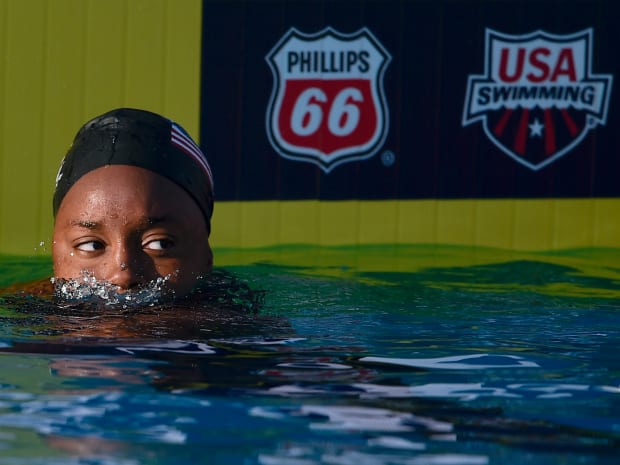
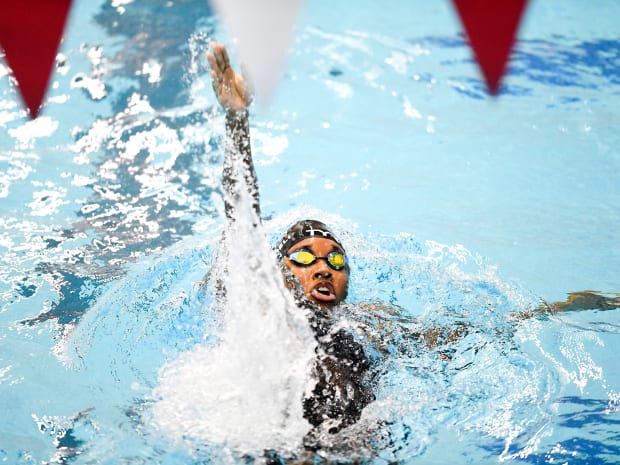
U.S. Olympic swimmer and gold medalist Simone Manuel sees the events of 2020 as an opportunity to use her platform to further conversations about race and advocate for more diversity in swimming.

The beliefs, convictions and frustrations have been there for years, percolating. Sometimes they went unspoken. Sometimes they were articulated in measured tones. There was no yelling, at least not in public.

In 2020, Simone Manuel is raising her voice.

“I feel in the past, I used my platform,” she told Sports Illustrated. “But not loudly.”

Always proud. Now, loud and proud.

Manuel’s increased volume has coincided with a particularly acute moment in America, and the result is a powerful alchemy. An articulate, 23-year-old gold medalist who will be one of the marquee faces in Tokyo next summer—if there is an Olympics next summer—has a multi-layered message she is shouting out on social media and elsewhere.

About being a Black superstar pushing for diversity and inclusion in the overwhelmingly white sport of swimming. About being Black in America in a year when George Floyd and Breonna Taylor were killed by white cops. About registering to vote, and then voting. About wearing a mask for the good of everyone. About so many things happening here and now.

“These are conversations I’ve had with my parents for years,” Manuel said. “I’ve always had a drive to want to speak out loudly. But I think it’s more accepted to speak your truth now, without people saying, ‘Uh, no-no, that can’t be true, that couldn’t have happened, that can’t be racist.

“I think people are more accepting hearing about it. People have tried to understand more where I’m coming from.”

More people are ready to have the conversation. And Manuel is more than ready to be a conversation starter.

Really, this began for Manuel before the terrible events of the spring pushed the Black Lives Matter movement to the forefront of American discourse. Before the ensuing protests ricocheted around the country. Before there was a pandemic that rocked the world.

It began in January, with a conversation between Simone and her mom, Sharron. At issue: How outspoken is too outspoken? Or not outspoken enough?

In the buildup toward Tokyo 2020, Manuel had become an increasingly attractive pitch woman for major corporations—Toyota, Nike, Coca-Cola, TYR swimsuits and others have signed her up. A Black swimming star with a Stanford degree, a sharp mind, a winning smile, status as the foremost female freestyle sprinter in the world—she was an advertising dream.

But corporate dollars can come with corporate handcuffs, and in the swimming world endorsement money is infamously elusive. Manuel had always advocated for a more diverse swimming community; could she now push the envelope further on other race-related issues without risk to her shiny public image?

“We were just kind of going over what you want to do and where you want to be,” Sharron said. “I just said, ‘Well, Simone, at some point you just have to tell your story.’ All this arose from what was already simmering. Deep down inside, she always knew she was going to have to speak on these issues—not politics, but humanity and equality. She wanted to be authentic and raw with the truth.”

So Sharron’s advice was simple: Say what comes to your heart, Simone. So she has. This is no bland athlete avoiding opinions to go along and get along.

There have been Instagram and Twitter posts that flash anger at persistent racism. There have been soul-searching posts that articulate disappointment and sadness, including a May 28 Instagram treatise that ends thusly:

“The words ‘freedom,’ ‘justice,’ and ‘equality’ are uttered by many, BUT do we really experience it? No! We have yet to experience it collectively as a nation, and we won’t until we all come together and fight for it … until we’re ‘all in this together.’

“If this makes you uncomfortable, check your privilege. Think of those who lack comfort EVERY SINGLE DAY.”

Reaction has been predominantly positive, from rank-and-file fans to corporate backers. In fact, Manuel is one of four Olympic or Paralympic athletes featured in a

new Proctor & Gamble spot that champions their activism.

Critics? There have been a few. But this is what you sign up for by raising your voice.

“I’ve gotten a lot of [direct messages] of support,” Manuel said. “But also DMs from people saying they don’t care what I think. There are people who want you to shut up and swim.”

“You can’t constantly be worried about who is mad at you,” Sharron Manuel said.

America was overwhelmingly happy with Simone Manuel in 2016 when, as a 19-year-old Olympic rookie, she won four medals—two gold—and became the first Black swimmer to win an individual swimming gold. Her star was just ascending.

A year later at the World Championships in Budapest, Manuel won five gold medals and one silver, then skipped her final season at Stanford to turn pro. Last year in South Korea, Manuel became the first woman swimmer to win seven medals at the World Championships, collecting four gold and three silver.

But like the rest of the American contingent, it was an up-and-down meet for Manuel. The expectation was seven medals, with maybe a couple more of them gold. A disappointing relay performance was followed by a near-disaster in qualifying heats for the 100 freestyle, when she barely snuck into the final in Lane 1.

When Manuel pulled out the win from the outside, her reaction wasn’t the surprised elation of gold in Rio in 2016. It was a head-dropping exhale.

“It was definitely a sigh of relief,” she said. “There was a lot of weight on my shoulders.”

Sharron and Marc Manuel have sensed the weight for a long time on the youngest of their three children. She was very good, very young, but also in a lonely spot—far more advanced than her friends, and of course, a racial anomaly. When she made the USA Swimming National Team at the tender age of 15, the family got Simone a sports psychologist to help her navigate all the was suddenly arising in front of her.

“I knew this kid was going to have to deal with a lot,” Sharron said. “And a lot will be expected.”

Even now, Manuel carries something extra with her to Stanford’s Avery Aquatic Center pool deck every day. This is the world's greatest freestyle training ground, from sprinter Manuel to distance legend Katie Ledecky, and while the two swim almost entirely different events (maybe crossing over at the 200-meter free), they share the weight of greatness.

It is, at times, a lonely task for the both of them—but Simone is also the racial outlier. Some days, the person tagged as America’s Greatest Black Swimmer may look around and wish someone else was asked all the race-related questions, but few others look like her.

“The more she’s done, the more pressure she’s felt as being part of this community,” Sharron said. “She doesn’t want to let everyone down. When she shows up, she’s showing up for a community. That’s something she does still occasionally stress about. Sometimes she needs to give herself a break.

“It isn’t always easy being one of very few in a sport. The price can be very high.”

It can be a burden at times. But also an opportunity. And the confluence of events in 2020 has produced a louder, prouder Simone Manuel.

Read More

New on Sports Illustrated: The Curious Case of the Electrified Épée

July 21, 2020 0

The Summer Games, which were supposed to open this week, have seen their share of cheaters—but none as bold as Boris Onischenko.

The phone call comes at the supper hour. A Ukrainian number. The voice—speaking Russian—is polite, formal, unwavering.

“Would you be ready to meet with us?”

“No.”

“So you do not want to?”

“Absolutely not.”

“Why? Because it is painful to talk about?”

“It’s a painful wound for me. I don’t want to trouble myself, and you as well. I don’t want to exculpate myself. I don’t want to talk about who I am, bad and good. I am very thankful for your care, but I refuse to cooperate with you.”

The man is old now, 83 in September. He will not trudge a winding staircase to his personal attic and rummage through the lock box of memory, brushing cobwebs off a sultry, long-ago July morning to offer a why or a how for your benefit. He seeks neither your comprehension nor your absolution. He will offer no remorse or penitence. He will make no effort to place the day in context, to frame the event in the whorl of his times.

The story is dead. After 40 seconds, the conversation is dead.

“Всего хорошего,” he says. “Всего хорошего.”

All the best. All the best.

And with that, the greatest cheat in Olympic history hangs up.

***

Seven a.m., July 19, 1976. The athletes’ bus from the Olympic Village is snaking six miles southwest to the Université de Montréal as unlikely seatmates conduct business. They are of different cultures, of different countries and of different stature in their sport, modern pentathlon. Andy Archibald, Great Britain, is a team alternate. Boris Onischenko, Soviet Union, is a titan. He has won a world championship and an Olympic silver medal and been part of gold-and-silver-medal-winning Olympic teams. These men do have one thing in common, the basis for the transaction: They are left-handed, which, as the day unfolds, will be a significant detail.

Archibald particularly admires the custom-designed orthopedic grips of Onischenko’s épées. Through the years Archibald has been a reliable customer. Western pentathletes buy their own swords while the Soviets, mostly military men, have theirs supplied. So instead of paying 15 pounds sterling for a sword, Archibald can spend perhaps a third of that for a used Onischenko épée. Win-win. In rudimentary German, a shared language, the seatmates strike a deal, agreeing to finalize it at the conclusion of the five-day event.

This is the second day of competition. Of the five disciplines—riding, fencing, shooting, swimming and running—this sweltering Monday should belong to Onischenko. No pentathlete wields his épée with more skill or intent. A century earlier, when fencers were bound by honor instead of electric circuitry and body cords, Alexandre Dumas or some other ink-stained romantic might even have called him a swashbuckler.

By the end of the week he knows he will no longer need those swords. Onischenko turns 39 in two months and has scraped onto the team for Montreal, his third Olympics, but he will be long retired when the Games come to Moscow in four years. This will be a final grab for an individual Olympic title that will be worth more than its weight in gold. A victory will secure a promotion in the MVD, the Interior Ministry, where he holds the rank of captain, and likely lead to the perks that go to Olympic heroes: a bonus, better housing, a more comfortable future in the USSR.

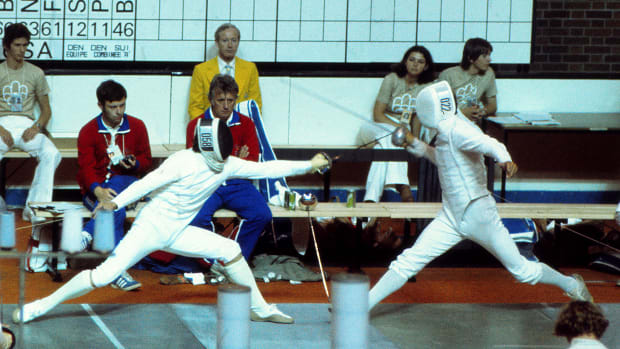
At 8 a.m. on Piste E, the Soviets begin fencing against their countrymen. In one bout Onischenko faces Pavel Lednev, the reigning three-time world champion and the favorite for individual gold but not Onischenko’s equal with a sword. At the USSR Olympic trials, Onischenko had the vast majority of his bouts. “I fenced him six or eight times over the years,” says Mike Burley, an American pentathlete who placed 16th in the 47-man field in Montreal. “He always cleaned my clock. I was always hoping to get lucky, but against a guy like him you don’t get lucky.” Onischenko wins both intrasquad fights. At 8:45, bouts start against other nations. Great Britain is first.

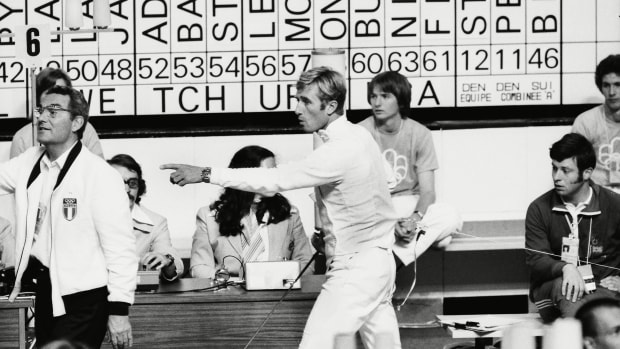
Onischenko’s initial opponent is Adrian Parker, another lefthander. Onischenko lunges, and the light signaling a hit goes on. (A hit, scored when the tip of the épée is depressed, closes the open electrical circuit by making contact between the two wires that run the length of the sword to the base inside the bell guard. The circuit continues from a plug near the handle through the body wire in the fencer's jacket, through the electric spool, and to the scoring box, which triggers a red or green light to indicate who scored the hit.) Fight over. Onischenko’s touch seems too good to be true, at least to Parker. He removes his mask and protests to referee Guido Malacarne that he hasn’t been hit. Following a cursory examination of Onischenko’s épée—all swords must pass inspection before competition—the referee does not annul the touch.

“Adrian was pretty grumpy,” says Mike Proudfoot, the Great Britain team manager who estimates he was less than two meters from the piste. “But at that point my job was not to let it affect Fox.”

Jeremy Fox—known as Jim to everyone but his mother—is Britain’s fair-haired, blue-eyed boy, the very model of the modern modern pentathlete: worldly, mannered and James Bond handsome. He is held in the highest regard inside the sport and out. Fox possesses a singular gift, the ability to talk to royalty or rogues and make everyone around him feel special. “One of his favorite expressions was ‘it takes [no] effort to be nice to people,’” Archibald says. Fox, a four-time Olympian, has fenced Onischenko often, notably at the 1972 Games, when Onischenko took the silver medal and Fox placed fourth. Four years later their dance begins anew.

Modern pentathlon épée bouts end with a single legitimate hit or after three minutes if there are no touches. Fox and Onischenko are 40 seconds from the end—both will be assessed a loss if no hit is scored—when Fox lures Onischenko into an attack. In Richard Cohen’s 2002 exhaustive history of fencing, By the Sword, Fox describes the finish this way: “I was still outside hitting distance when I picked up Onischenko’s blade—really high, before his blade was anywhere near me. His blade was above my head. And I smacked [my point] into his chest, but the light was already on [against me.]” The hit is implausible at best, physically impossible at worst. At the instant Onischenko’s touch registers, the tip of his épée is pointing skyward.

“We hadn’t started yet, so we’re watching their match,“ Canadian pentathlete Jack Alexander recalls. “We’re sitting next to our coach, [Joe Bucsko], who was a real exaggerator. The light goes on and he says, ‘Boys, Onischenko’s so fast you couldn’t even see it.’ And all three of us are going, ‘Coach, he didn’t touch him.’ ”

Onischenko (left) was initially—and wrongly—awarded a hit in his bout with Fox.

Malacarne, who later would say he was paying closer attention to Onischenko after Parker’s protest, instantly reaches the same conclusion and annuls the hit. Onischenko does not object. “He apologized straight away,” Proudfoot says. “Sorry. Sorry, Jimmy, I’ll change my weapon.” Fox is not assuaged; merely swapping épées might allow Onischenko a chance to use the same one later to score more dodgy hits. As Malacarne tells Cohen in By the Sword, the Soviets actually produced a different épée for closer inspection—an impromptu game of three-sword monte. Despite the pantomime—Soviet team members deny there was any trickery—Malacarne seizes the correct épée. He summons the appeals jury to the piste to examine it. An hour later a public address announcement says Onischenko’s sword was found to have been faulty, and his score would be docked a trivial number of points.

The British team considers the penalty a slap on the wrist, which, in its view, is more contact than Onischenko ever made with Fox or Parker. Proudfoot begins writing an official protest by hand to argue that Onischenko’s faulty sword constitutes deliberate cheating, which should result in disqualification. At 10:40 he files the protest to the governing body, the Union Internationale de Pentathlon Moderne. A $25 filing fee is attached. The Montreal Games will become notorious for their staggering cost overruns, but 25 bucks is a wise investment even if the merciless gaze of a young fencing enthusiast already had detected chicanery. Twelve-year-old Nicholas Bacon, who is awaiting surgery for a brain tumor, has been watching the British matches intently. He turns to the woman seated next to him, a family friend, and announces that Onischenko is cheating. The woman, Bacon’s hostess, is Mary Glen-Haig, a formidable figure in fencing, a daughter of a 1908 Olympic fencer, a four-time Olympian herself and a future member of the International Olympic Committee. She pulls rank. Glen-Haig strides towards the pistes and collars the head of the fencing competition, telling him confiscation of the sword and a point deduction are insufficient penalties.

Voilà, les jeux sont faits. The officials who removed the sword discover a break in the grip’s insulation, although initially they can’t determine whether the cut has been made deliberately. But Glen-Haig’s blunt intervention has unsettled the modern pentathlon officials. The head of the International Fencing Federation, a Belgian named Charles Debeur, arrives to personally dismantle Onischenko’s épée. His inspection reveals that this is a matter of engineering, not happenstance.

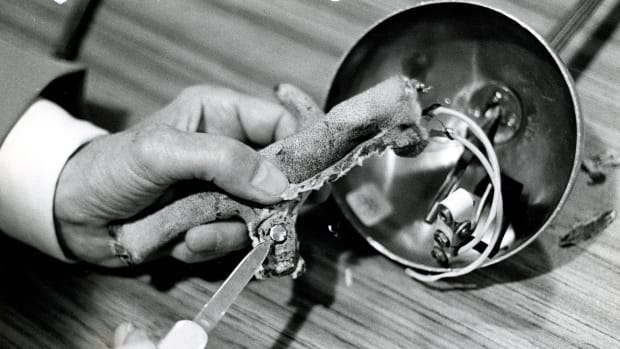
A hole has been drilled in the grip, which has been covered by a snug-fitting chamois cloth. Inside the custom-made grip is a metal button. Onischenko simply has to press the button with fourth and pinky fingers to close the electrical circuit, turning on the light. No touch required. He can register a hit with impunity and conserve energy for the next three days of competition. In the one-page judgment of the jury d’appel, which includes Debeur, the rigged épée is incontestablement un cas de fraude. The smoking sword.

Sandy Kerekes, a Hungarian-born Montrealer, is the modern pentathlon competition director. The scene is preserved in his mind’s eye: He walks into his cramped office, and the three-member jury d’appel is seated in front of him. The sword, its grip laid bare, rests on a table. Onischenko is to his left. “He is almost collapsed in his chair as if the world had collapsed around him,” Kerekes says. “This was shame in front of the world. All the questions were asked. He never answered one. He claimed innocence.” (According to By the Sword, Onischenko later argues the rigged sword isn’t his, an alibi that stretches credulity like it’s taffy. Remember, he is left-handed. Every other member of his team, including alternate Vladimir Shmelev, is right-handed.) Kerekes again: “Calculated cheating. In athletic terms the crime he committed was a total murder.”

In accordance with the UIPM Rule book of 1974, articles 3.121 c, 1.36 and 1.37, Onischenko is disqualified. His name is removed from the venue scoreboards. Around 12:30, Alexander, the Canadian, steps into the hallway in time to see Onischenko hustled off by Soviet officials.

Proudfoot describes the exit similarly: “On this very hot day two guys appeared looking like what we thought of as typical KGB stooges. Two guys in trench coats and droopy hats. They took him by the elbows and removed him from the arena.” Onischenko’s swash is buckled.

Tuesday morning, July 20, a fencing story, apparently for the first time in its history, runs on A1 of The New York Times. Imagine. Twenty-four hours earlier Onischenko had been obscure, a champion whose triumphs in an anachronistic sport were recorded in agate type. Now he is a front-page fraud. A punch line. He quickly will be nicknamed Boris Dis-Onischenko because low-hanging fruit is the most tempting.

***

Last Feb. 25, the day an old man in Ukraine returns a Sports Illustrated call and firmly declines an interview, the IOC announces sanctions against Albanian 200-meter runner Klodiana Shala. In a retest of samples from London 2012, Shala’s came back positive for Stanozolol.

Stanozolol is an old-school anabolic steroid that crashed the Olympic lexicon in Seoul 1988, the wind beneath the wings of Ben Johnson, who had run 100 meters in 9.79, faster than any man before. Johnson’s failed doping test is often considered the biggest Olympic scandal because it occurred after the most anticipated event of the 17-day carnival, his showdown with Carl Lewis. This, of course, doesn’t make Johnson the greatest Olympic cheat—merely the most memorable. Six of the eight men in that race would be linked to PEDs. In future Summer Games, doping disqualifications would become depressingly common, primarily in athletics, which accounted for roughly two-thirds of the positive tests in London. In a more trusting time, Johnson’s positive drug test evoked shock and, in Canada, soul-searching in the form of a government inquiry into steroids in sport. After the incessant thrum of Balco and Lance Armstrong and Russia’s state-sponsored doping, the Seoul scandal is greeted three decades with a sad, knowing nod. Big Ben, greatest five-ringed cheat? Please. Cycling through PEDs doesn’t require much more than a supplier, a syringe, a protocol and a cracked moral compass.

Onischenko’s scam, on the other hand, was ingenious. He had moxie. He, or some devious helper, had a grasp of electronics. His guile could make a 2017 Houston Astro blush. Onischenko put the skull in skulduggery.

“It was unique,” Olympic historian Bill Mallon says. “Almost all the other cheating has been related to PEDs. There were some gender identity things at the [1936] Berlin Olympics and in the early ’60s, but nothing with rigged equipment.”

Onischenko’s épée had a button in the handle that allowed him to score at will.

If memory of Onischenko’s ruse has faded with the years, it’s because his is a sport that hides in plain sight. While other Olympics sports vanished or went on hiatus—adieu, tug-of-war; grab some bench, baseball—modern pentathlon has just sort of been a face in the crowd. The modern Games began in 1896; modern pentathlon has been on the program since 1912. If that inaugural competition is noteworthy, it’s only because the USA featured a brassy West Pointer named George S. Patton Jr., who placed fifth primarily because of a poor shooting performance; Patton would wind up on the podium in World War II.

Curiously, Pierre de Coubertin, creator of the modern Olympic movement, also founded modern pentathlon. (As father of an aggregation of military-type sports, de Coubertin is less James Naismith with peach baskets than Arianna Huffington with websites.) Modern pentathlon replicates the actions of a 19th-century French courier who rides, fences, swims, shoots and runs to deliver his message. (In his Modern Pentathlon, a Centenary History: 1912-2012, Archibald writes that de Coubertin originally favored rowing over shooting.) Modern pentathlon never realized de Coubertin’s grand vision of its champion being hailed as the ultimate Olympian, but in 2013 the IOC confirmed modern pentathlon—now streamlined to one or two days—as one of 25 core sports, at least through Tokyo 2020.

For all its relative anonymity, Olympic modern pentathlon offers another notable breach of propriety, one that predates Onischenko’s. The solecism occurred in Mexico City 1968, one year after the IOC introduced drug-testing protocols. Apparently to calm his nerves before the pistol shooting, Hans-Gunnar Liljenvall knocked back a couple of beers and tested positive for excessive alcohol, earning the dubious honor of being the first Olympian disqualified for doping. Compared with tampering with an épée, being turfed for a few brews seems overzealous. Liljenvall, a Swede, simply was putting the skol in skullduggery.

***

The 12-hour day at the venue is done. They are gathered in the British team room at the Olympic Village, marveling at the events of the morning, trying to make sense of a fencing fever dream. Fox is taking it particularly hard. He respects Onischenko and assumes the feeling is mutual. The rigged sword has rattled him. Fencing poorly, Fox ties for 18th on the day and now offers a sweeping apology. He says he likely has deprived Great Britain of a team medal. He announces he will consider dropping out.

At 10 p.m., there is a knock at the door. Surprise visitors. Pavel Lednev and Vladimir Shmelev.

They are friends with the British athletes, or at least something as close to friends as the ’70s Iron Curtain permits. Over the years the Soviets have introduced Fox to vobla—salt-cured fish—and Fox has bought Shmelev jazz records. Ella Fitzgerald. Louis Armstrong. They now apologize for the scheming Onischenko. “[Onischenko] had a reserved character,” Shmelev tells SI. “Like a lone wolf. Always alone, alone, alone.” When asked last May about the substance of the meeting, Shmelev says he and Lednev denied any knowledge of the crooked sword and told the British team that they were being allowed to remain in Montreal to compete individually.

Proudfoot recalls the conversation, conducted in English, as more revealing. “They were actually pleased with what had happened to Onischenko,” he says. “They said he had been reporting everything they did back to the authorities. This was the middle of the Cold War. And they had been doing black-market trading during their travels outside the Soviet Union. Caviar. Cameras. Stopwatches. They suspected Onischenko had [cheated] before. They commented on how well he had done at the USSR trials and that maybe he had been trying out his magic device then. … They seemed eager to disassociate themselves from Onischenko’s cheating. They were very keen to exculpate themselves.”

After 20 minutes the visitors leave. Two days later at the Olympic pool, Fox and Shmelev discuss Onischenko again. As a token of fellowship, Fox hands Shmelev a memento. “We didn’t have those types of things,” Shmelev says. “And they had these blue towels that said ‘Great Britain Modern Pentathlon.’ I still have that towel.”

***

The two men in the trench coats and droopy hats escort Onischenko to a Soviet ship docked in the port. He is confined to a cabin. Onischenko is front-page news in the Times, but the Montreal Gazette, seduced by Nadia Comaneci’s historic 10s, plays his caper on the seventh page of its Olympic coverage. The following day he is about to be stripped of his Soviet sporting honors, but he earns a promotion in the Gazette, to Page 3. An eight-paragraph story quotes an unnamed USSR official saying cheating is “a very sad matter.” The official adds, “The team did not know about it. The trainers did not know about it. It is a tragedy for the entire team. These are not our methods.”

The oft-repeated version of Onischenko’s next few days: He flies to Moscow, where Communist Party leader Leonid Brezhnev dresses him down, strips him of his rank and fines him 5,000 rubles. The details are mere curlicues to the script of the story, writ large in the West. “This affair,” Archibald says, “was wonderful propaganda.” Seven years before Ronald Reagan’s Evil Empire speech, at the height of a surrogate war being fought, in part, with games instead of bullets, Onischenko fit the tidy narrative: the duplicitous USSR and its East Bloc underlings vs. the noble U.S. and its upstanding allies. After Ben Johnson and so many other sporting scofflaws, dirt will be spattered practically everywhere. Not in 1976.

Rumors fly about Onischenko, beginning that afternoon in Montreal. They will for years. The most repeated has Onischenko being found dead, floating in a Moscow pool.

The truth is less le Carré. Onischenko doesn’t drown. He doesn’t kill himself. And he never is far from public view, at least in his hometown of Kiev. Several years after the Olympics, he attends the Soviet modern pentathlon championships there; Lednev and Mosolov spurn him. In 1985, Martin Dawe, a British pentathlon official, spots Onischenko in the crowd at the world junior championship in the city.

So what was he doing? Reportedly he was an athletic administrator. An August

2005 story in a Ukrainian newspaper, Ukrayina Moloda, mentioned that

Onischenko had been heading the Atlet sports base since its founding 28 years

ago, a facility located on the grounds of the Olimpiyskiy National Sports

Complex in Kiev. Five years earlier, on a BBC 5 radio program that aired Christmas

Day 2000, its correspondent reported that Onischenko said he was working in a sports training

facility, teaching fencing. (The name of the series airing the Onischenko segment was Scandal!). The correspondent also mentioned Onischenko inquired about Jim Fox.

Fox, who wasted little time protesting Onischenko’s apparent win, ultimately won gold in the team competition.

Three years earlier, in 1997, Fox was diagnosed with Parkinson’s disease. He now lives in a residence, which is under quarantine because of COVID-19. On March 5, before the lockdown, 79-year-old Jim Fox, MBE, OBE, a recipient of the Olympic order, meets British modern pentathletes at their training center in Bath. Fox finds speech difficult on many days and was unavailable for an interview although Lieutenant Colonel (Ret.) Stuart Cowen, a friend, says, “Jim was devastated. He just thought Onischenko’s kit was a bit faulty. Jim told me, “’He didn’t need to cheat. He was the best fencer in the world.’”

***

No how. No when. No why.

There are gaping holes in this story of the greatest Olympic cheat. Maybe he masterminded and executed the caper himself. It seems probable but not provable that he had an accomplice. He could have been practicing his dark arts for months if not years. Or maybe he debuted his con on a pit-stained Monday in Montreal. Only Onischenko can say with certainty, and he will say nothing. No exculpation, no explanation.

Into the void, conjecture rushes in.

Mike Proudfoot: “The simple explanation is that he had achieved everything except [an individual] Olympic gold medal. This was his last chance.”

Andy Archibald: “This was a last desperate stab for immortality.”

Sandy Kerekes: “It had to be his own ego and materialism.”

Mike Burley: “Those guys from the Eastern Bloc would be pretty much set for life if they won a gold medal. The bottom line is it was so much more important to the guys on the other side of the wall.”

Proudfoot and Archibald share the opinion that Onischenko likely first used the rigged épée in Montreal if for no other reason than he bungled the job so badly. Diabolical in design, Mr. Bean in execution. Onischenko could register a hit at will, but inept timing beggared belief in the touches. Maybe he choked under Olympic pressure, but a more practiced trickster wouldn’t have pushed the button with his sword pointed skyward. On the biggest stage, Onischenko was as convincing as the schoolboy who signs a failing report card “My Mom.”

One man on the piste that day strongly suspects this was not Onischenko’s first time. He tells a darker tale. He is from the other side of the wall.

***

In mid-April as spring poked its head out, scanned the countryside and wondered whether it was safe to go outside, Boris Mosolov answers his phone. He is at his dacha north of Moscow, hunkered down with his cats and dogs. Mosolov is the other USSR pentathlete in Montreal, the third and youngest member of the team. He turned 70 in June, a man who carries a grudge as impressively as Russian soprano Anna Netrebko carries a tune. Forget? Hardly. Forgive? Not a chance. Mosolov recalls having to hide his accreditation to avoid hard glances and impertinent questions at the Village. How does that make an athlete feel? His teammates would achieve infamy or distinction—Lednev was inducted with the Modern Pentathlon Hall of Fame's inaugural class in 2016, six years after his death—but, unlike them, Mosolov would never win an Olympic medal nor compete in another Games. His Olympics turned to ashes.

During a 50-minute interview, Mosolov does the math. He calculates that if Onischenko had placed as low as 35th, the USSR still would have won the team gold. “I lost a lot because of it, materially and morally,” says Mosolov, who finished eighth. “The title of Olympic champion gives you a lot in Russia today—a pension and so forth. I’m stripped of all that because of him.”

Mosolov thinks the catalyst for the rigged épée was Onischenko’s failure to make the team for the 1975 world championships. The following summer, Montreal would be his last shot at an individual Olympic gold, assuming he qualified. Mosolov suspects Onischenko introduced the rigged weapon in April 1976 at a London event that counted in the selection process. But at the subsequent Soviet championships, before Montreal, Mosolov says Onischenko’s cheating was “unambiguously visible. People openly talked about it.” When confronted by competitors, Mosolov says, Onischenko was dismissive.

“The thing is I won the [Soviet championships] bout against him. He tried, of course. He knew who he was competing against,” Mosolov says. “[But] against second-rate athletes, he didn’t even beat around the bush. Whether he touched or not, the light would light up.… He was told about it. But he told everybody off. ‘I’m above that and that’s it.’ That’s how he was. Stubborn.”

Ultimately Onischenko’s mulishness might have contributed to his disqualification. Contradicting Western accounts, Mosolov says the weapon lay under a table as the fencing continued. “It was visible,” Mosolov says. “If Onischenko had said it was a rigged épée and it needed to be put away at all costs, theoretically Shmelev could have done that easily. If Onischenko had been a normal person, this is what would have happened. [But] he remained the asshole he was. He said everything’s fine. It’s clean. Although I know he was looking at that épée and seeing his own death.” As Russians are fond of saying, hope dies last.

So these are some answers to the how-when-why questions. One man’s answers, anyway. “Honestly, I think it’s even worse than doping,” Mosolov says. “With this button he deprived a competitor. It’s very revolting to me that a person resorts to that for the sake of his personal credo.”

In retrospect, Mosolov wonders whether seeds of the scam were planted even earlier. In 1972 Onischenko returned to Kiev a decorated Olympian, winner of the individual silver and the team gold for the USSR. His performance was splendid, but a fellow Ukrainian’s overshadowed it. Valery Borzov won the glamor events in Munich, the 100- and 200-meter sprints. He had international glory. Mosolov says, “Back home they hadn’t greeted him like Borzov. How can that be? I’m also an Olympic champion. I also have everything, but I’m not appreciated. That’s my opinion: He needed to be the most important [Olympian] in Kiev.”

***

Sandy Kerekes is 95. Over a Wiener schnitzel lunch at Foyer Hongrois in early March, a Hungarian seniors residence on the edge of downtown Montreal, he says he sometimes still dreams about Onischenko. Kerekes was nurtured in a prelapsarian sporting world and believes athletic competition—especially his sport—is meaningless if devoid of honor. Once Onischenko made the conscious decision to cheat, Kerekes says, “There were two ways for this to end. He could get caught. Or if he didn’t get caught and won, he would’ve been a total goddamn heel in his own head. This would have represented a downfall of a human mind. He would have lost his honor even if he would’ve been a hero for society and history.”

Honor, yes. That was ceded at the press of a button in an orthopedic left-handed grip. But Mosolov’s pension aside, not all was lost because the coda to this Olympic tragicomedy provides, in its way, a happy ending. Onischenko has no need for your forgiveness, because he received Fox’s long ago. “Jimmy forgave him,” says Dawe, the British official. “He felt Boris was under pressure to perform, which is what drove him to it.” Although disgraced, Onischenko is no international man of misery, seemingly having lived in relative comfort into old age. “They didn’t put him in jail,” Mosolov says. He laughs. “That wasn’t really done in practice, but they stripped him of all his titles. But no one can take that [1972 gold medal] from him. He’s an Olympic champion. And he’s still seen in Kiev as an Olympic champion.”

And there is this: Days after modern pentathlon stumbled onto the front page, Fox, Parker and Danny Nightingale took the team gold medal in a sizable upset. Win-win.

“Generally people in the sport don’t think evil of Onischenko,” Archibald says. “People understand the desperation of an act like that. He did get caught. He did get his comeuppance. But honestly the affair is viewed as something exciting. There’s a little Three Musketeers about pentathlon. The horse messenger galloping across the plain and all that. You need a little romance. It sells ourselves to the world.”

Special reporting by Gabrielle Tétrault-Farber.

Read More

Copyright © 2019 Tech Location BD. All Right Reserved